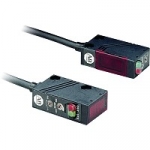
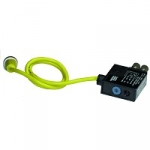
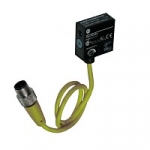
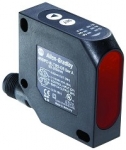
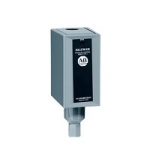
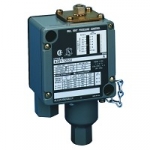
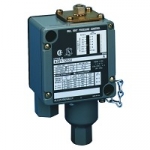
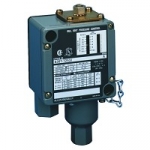
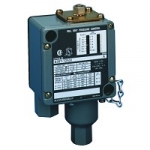
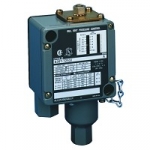
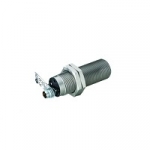
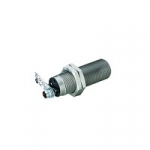
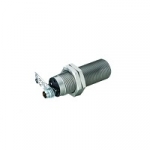
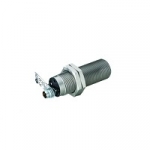
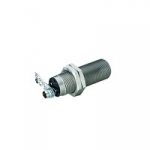
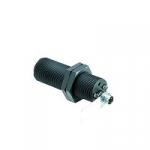
Sensors
How do sensors work?
A Capacitive Measurement System
Capacitive sensor dimensional measurement requires three basic components:
A probe that uses changes in capacitance to sense changes in distance to the target, driver electronics to convert these changes in capacitance into voltage changes, a device to indicate and/or record the resulting voltage change.
Each of these components is a critical part in providing reliable, accurate measurements. The probe geometry, sensing area size, and mechanical construction affect range, accuracy, and stability. A probe requires a driver to provide the changing electric field that is used to sense the capacitance. The performance of the driver electronics is a primary factor in determining the resolution of the system; they must be carefully designed for a high-preformance applications. The voltage measuring device is the final link in the system. Oscilloscopes, voltmeters and data acquisition systems must be properly selected for the application.
What is Capacitance?
Capacitance describes how the space between two conductors affects an electric field between them. If two metal plates are placed with a gap between them and a voltage is applied to one of the plates, an electric field will exist between the plates. This electric field is the result of the difference between electric charges that are stored on the surfaces of the plates. Capacitance refers to the “capacity” of the two plates to hold this charge. A large capacitance has the capacity to hold more charge than a small capacitance. The amount of existing charge determines how much current must be used to change the voltage on the plate. It’s like trying to change the water level by one inch in a barrel compared to a coffee cup. It takes a lot of water to move the level one inch in the barrel, but in a coffee cup it takes very little water. The difference is their capacity.
When using a capacitive sensor, the sensing surface of the probe is the electrified plate and what you’re measuring (the target) is the other plate (we’ll talk about measuring non-conductive targets later). The driver electronics continually change the voltage on the sensing surface. This is called the excitation voltage. The amount of current required to change the voltage is measured by the circuit and indicates the amount of capacitance between the probe and the target. Or, conversely, a fixed amount of current is pumped into and out of the probe and the resulting voltage change is measured.
How Capacitance Relates to Distance
The capacitance between two plates is determined by three things:
Size of the plates: capacitance increases as the plate size increases 
Gap Size: capacitance decreases as the gap increases
Material between the plates (the dielectric):
Dielectric material will cause the capacitance to increase or decrease depending on the material
In ordinary capacitive sensing, the size of the sensor, the size of the target, and the dielectric material (air) remain constant.
The only variable is the gap size. Based on this assumption, driver electronics assume that all changes in capacitance are a result of a change in gap size.
The electronics are calibrated to output specific voltage changes for corresponding changes in capacitance. These voltages are scaled to represent specific changes in gap size. The amount of voltage change for a given amount of gap change is called the sensitivity. A common sensitivity setting is 1.0V/100µm. That means that for every 100µm change in the gap, the output voltage changes exactly 1.0V. With this calibration, a +2V change in the output means that the target has moved 200µm closer to the probe.
Focusing the Electric FieldWhen a voltage is applied to a conductor, an electric field is emitted from every surface. For accurate gaging, the electric field from a capacitive sensor needs to be contained within the space between the probe’s sensing area and the target. If the electric field is allowed to spread to other items or other areas on the target, then a change in the position of the other item will be measured as a change in the position of the target. To prevent this from happening, a technique called guarding is used. To create a guarded probe, the back and sides of the sensing area are surrounded by another conductor that is kept at the same voltage as the sensing area itself.
When the excitation voltage is applied to the sensing area, a separate circuit applies the exact same voltage to the guard. Because there is no difference in voltage between the sensing area and the guard, there is no electric field between them to cause current flow. Any conductors beside or behind the probe form an electric field with the guard instead of the sensing area. Only the unguarded front of the sensing area is allowed to form an electric field to the target.
Effects of Target Size
The target size is a primary consideration when selecting a probe for a specific application. When the sensor’s electric field is focused by guarding, it creates a field that is a projection of the sensor size and shape. The minimum target diameter for standard calibration is 30% of the diameter of the sensing area. The further the probe is from the target, the larger the minimum target size.
Range of Measurement
The range in which a capacitive sensor is useful is a function of the area of the sensing surface. The greater the area, the larger the range. The driver electronics are designed for a certain amount of capacitance at the sensor. Therefore, a smaller sensor must be considerably closer to the target to achieve the desired amount of capacitance. The electronics are adjustable during calibration, but there is a limit to the range of adjustment.
In general, the maximum gap at which a probe is useful is approximately 40% of the sensing surface diameter. Standard calibrations usually keep the gap considerably less than that.
OPERATING PRINCIPLES FOR INDUCTIVE PROXIMITY SENSORS
Inductive proximity sensors are used for non-contact detection of metallic objects. Their operating principle is based on a coil and oscillator that creates an electromagnetic field in the close surroundings of the sensing surface. The presence of a metallic object (actuator) in the operating area causes a dampening of the oscillation amplitude. The rise or fall of such oscillation is identified by a threshold circuit that changes the output of the sensor. The operating distance of the sensor depends on the actuator's shape and size and is strictly linked to the nature of the material:

Outputs:
DC Voltage
2 wire DC: These sensors contain an output amplifier with the function N.O. or N.C. that can pilot a load connected in series. In this system a residual current flows through the load even when in the open state and a voltage drop occurs to the sensor when it is in the closed state. Attention must be paid to these restrictions when selecting relays or electronic controls to be used with these sensors. They are compatible with P.L.C. units.

3 & 4 wire DC: These amplified D.C. sensors contain an output amplifier. They are supplied as 3 wire with function N.O. or NC and as 4 wire with complementary outputs (NO + NC) in the types NPN and PNP. Standard version include protected against short circuit, protected against polarity and peaks created by the disconnection of inductive loads. They are compatible with P.L.C. Units
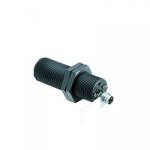
Analog & Linear: In these 3 wire amplified sensors a current or voltage output varies in proportion to the distance between the sensor and a metallic object.

NAMUR: These are 2 wire non-amplified sensors whose current varies in the presence of a metallic object. The difference between these sensors and traditional sensors is the absence of amplifier trigger stages. Their current and voltage limits allow them to be used in hazardous (explosive) environments when used with approved amplifiers. In standard applications (normal atmospheres) the sensor must be used with amplifier units ALNC, ALN2 or similar.

AC Voltage
2 wire AC: These are two-wire sensors that contain a thyristor output amplifier. In this system a residual current flows through the load even when in the open state and a voltage drop occurs to the sensor when it is in the closed state. Attention must be paid to the minimum switching current, residual current and voltage drop when selecting low consumption relays or high impedance electronic controls to be used with these sensors. They are compatible with P.L.C. Units
Connection and wiring for proximity sensors
For all types of proximity sensor including, photoelectric, inductive, capacitive and ultrsonic

NO (normally open): A switch output that is open prohibiting current flow when an actuator is not present and closes allowing current flow when an actuator is present.
NC (normally closed): A switch output that is closed allowing current flow when no actuator is present and opens prohibiting current flow when an actuator is present.
NPN Output: Transistor output that switches the common or negative voltage to the load. The load is connected between the positive supply and the output. Current flows from the load through the output to ground when the switch output is on. Also known as current sinking or negative switching.
PNP Output: Transistor output that switches the positive voltage to the load. The load is connected between output and common. Current flows from the device's output, through the load to ground when the switch output is on. Also known as current sourcing or positive switching.
Operating Distance (Sn): The maximum distance from the sensor to a square piece of Iron (Fe 37), 1mm thick with side's = to the diameter of the sensing face, that will trigger a change in the output of the sensor. Distance will decrease for other materials and shapes. Tests are performed at 20ºC with a constant voltage supply. This distance does include a ± 10% manufacturing tolerance.
Power Supply: The supply voltage range that sensor will operate at.
Max Switching Current: The amount of continuous current allowed to flow through the sensor without causing damage to the sensor. It is given as a maximum value.
Min Switching Current: It is the minimum current value, which should flow through the sensor in order to guarantee operation.
Max Peak Current: The Max peak current indicates the maximum current value that the sensor can bear in a limited period of time.
Residual Current: The current, which flows through the sensor when it is in the open state.
Power Drain: The amount of current required to operate a sensor.
Voltage Drop: The voltage drop across a sensor when driving the maximum load.
Short Circuit Protection: Protection against damage to a sensor if the load becomes shorted.
Operating Frequency: The maximum number of on/off cycles that the device is capable of in one second. According to EN 50010, this parameter is measured by the dynamic method shown in fig. 1 with the sensor in position (a) and (b). S is the operating distance and m is the diameter of the sensor. The frequency is given by the formula in fig. 2.
Repeatability (%Sn): The variation between any values of operating distance measured in an 8 hour period at a temperature between is 15 to 30ºC and a supply voltage with a <= 5% deviation.
Hysteresis (%Sn): The distance between the "switching on" point of the actuator approach and the "switching off" point of the actuator retreat. This distance reduces false triggering. Its value is given as a percent of the operating distance or a distance
Flush Mounting: For side by side mounting of flush mount models. Non-flush mount models can be embedded in metal for side by side
Protection Degree: Enclosure degree of protection according to IEC (International Electrotechnical Commission) is as follows:
IP 65: Dust tight. Protection against water jets.
IP 67: Dust tight. Protection against the effects of immersion
IP 69k: High pressure & High temperature wash down
Electroquip Camera and Selection advice guide.
Introduction
Camera selection for a specific application can be a daunting task for any user. We have compiled this guide for people who are new to the use of cameras and are bewildered by the vast range of product on offer. It is based on frequently
asked questions.
Should I choose an Analogue or digital camera ?
1). Generally the choice will be governed by the following factors :-
Price - for those applications were you want a low cost camera, then analogue will nearly always be your choice. They are generally considerably lower priced than digital cameras. However within the last year there are arriving on the market some very attractively priced digital cameras with 8 bit fire wire or USB2.0 interfacing. So the price advantage that analogue
cameras have had over digital will slowly be eroded.
Is your application purely to view a scene or to do measurements? If you just want to view a scene for example in a security application or in an industrial application where you are looking for the presence or absence of a part then an analogue camera will be fine. If however you want to carry out any form of measurements, processing or analysis on an image then a digital camera will always be a better choice. Digitising the image in the camera close to image sensor will always present a more accurate reproduction of the image data and hence a better result to work with. This does not mean measurements can not be done with an analogue camera it just means the result will not be so accurate.
What resolution do I need the camera to have?
2). Secondly you must decide what resolution you need. This is governed by the amount of detail you want to see, the optical lens and the working distance (i.e.:- lens distance to object). If the object being observed is large then around
standard VGA format of 640 x 480 will be fine. However, if fine detail is required (for example grain analysis in a microscopy application or small defects in glass plates) then a higher resolution will be required. A very simple rule of thumb is to decide the field of view you need and the size of the smallest detail you want to view and divide one by the other and multiply by 3 (e.g.: you are viewing a ceramic tile of 150mm wide and you need to see a defect of 1mm - to be sure of identifying the defect you need three pixels to be covering 1mm defect so therefore you will need at least 450 pixels to see the defect. If you were looking for the same 1mm defect in a 500mm tile then you would need at least 1500 pixels.
You will need this resolution in both directions and preferably in a 1:1 ratio so square pixel cameras will be desirable.
How fast is my image acquisition?
3). Next you must decide on the speed the acquisition needs to take. If the object is static this is not an issue and any camera will be suffice. If your object is moving along a conveyor it will need to be either a progressive area scan camera or a
line scan camera. Basically for fast moving events (faster than the eye can see) there are two types of camera.
Progressive Area Scan- this type of camera has the ability to read the image as a whole (rather than an interlaced camera that reads two distinct fields (odd and even lines) separated by 40ms time interval and then the resultant image is read out as a complete frame). Where on fast moving objects the interlaced camera gives image blur (because of the time difference the two fields are read out by the image sensor). The progressive cameras read all lines within the same scan and therefore no image blur is visible.
Line Scan cameras. Sometimes area scan cameras do not have the speed to capture data from a moving object. (example paper or textiles which may travel at many tens of meters a second) These applications demand cameras which can
read a line of data very fast. Also normally in this application the web is very wide sometimes many meters so therefore a high resolution camera is required. To deal with these issues a linescan camera is needed. Line scan cameras are a linear
image sensor (generally one row of pixels in the sensor - up to about 8000 pixels). Linescan cameras read data at many thousands of lines per second so can deal with defect detection in very fast moving objects.
Should I choose a Monochrome or Colour camera?
Generally our advice here is if you don't need colour detail always choose monochrome.
There are two reasons
1). Colour image sensors are monochrome sensors with a matrix colour filter across them. There are a number of different filters used but all filters will degrade the image sensor sensitivity by around 30 per cent. That means you will have to compensate with more light or lower iris setting to let more light into the optic.
2). The other problem is that in single chip colour cameras the resolution of the colour is degraded. This is because the filter colour for one pixel will be different from its neighbours. By software correction the resolution is corrected but it's a assumed correction so it will not be as accurate colour representation as that derived from a three sensor colour camera where there is a sensor for each of the prime colours (blue, green and red) and these are converged to overlap one another by clever optical mirrors in the camera head. For really true colour representation a three chip colour camera has no equal.
What's the difference between CMOS and CCD?
This is a big subject in itself but we will try and be clear on the main differences
CCD is more sensitive than CMOS mainly because the CCD chips generally have 100% fill factor where the CMOS is much less ( this means the CCD is 100% active sensor while the active part of the CMOS will be no more than 70% and some a lot less.
CCD is much better for low contrast images. This is because of the lower inherent noise in the sensor.
CMOS has the advantage of being much more flexible than CCD. You can window CMOS sensors to read out less data at a higher frame rate (i.e.: although a sensor may have a resolution of say 1280 x 1024 and readout rate of 15 frames
per second by windowing the sensor and only reading out a 640 x 480 portion of the image you can achieve a frame rate of nearly 70 frames per second could be achieved.
CMOS sensors have much lower power consumption and therefore are ideal for portable devices or space applications.
What type of output should my camera have ?
The type of output will be determined by how you want to read the data out from the camera.
If you want to read it out to a video monitor then an analogue output (either CCIR for monochrome) or PAL for colour will be the easiest. If you want to take the data to a PC then the choice is huge but basically as follows:
Analogue can still be used - you will have to interface to a frame grabber, there are number of inexpensive ones we can offer you so the cost need not be too high.
For undemanding applications USB2.0 will be easy and very straight forward. Fire Wire (IEEE1394) offers a solution that is also "plug and play" and some cameras are now available with high resolution. Please see our separate FAQ on the differences between USB2.0 and Fire Wire (IEEE1394) more.
Camera Link- the digital interface standard for those demanding applications. Is used with many high performance digital area scan and also line scan cameras. You will need a frame grabber designed for that type of interface. The price of this
interface is decreasing so is not as expensive as you may think.
There are also older types of LVDS RS644 interfacing still used for digital cameras but these are being phased out and replaced by Camera Link or Fire wire so is not recommended for new developments.
How do I choose a lens for my camera?
A camera is of no value without a lens or a focusing optic. In microscopy applications this is provided by the microscope manufacturer and with a suitable C mount adapter the camera can be directly coupled to the microscope.
For other applications the lens choice depends on:-
Field of view required - Working distance ( distance between front face of lens and object being viewed)
Size of detail required
Depth of field required
How you are going to use the data captured. (Accurate measurement applications for example may require the use of a telecentric or machine vision quality lens)
Features required from lens (most lenses are manual iris and focus but other options are available such as zoom and motorised lens control.
This guide is not extensive and is no substitute for speaking to an experienced engineers who will be able to assist in the selection of the right camera and lens combination for your application talk to one today at Electroquip
Product Search
Our Products
Electroquip, Glenmore Centre, Eurolink Estate, Sittingbourne, Kent, ME10 3GL.
VAT Reg No. 430 8963 41
Tel 01795 473714.
Fax 01795 429364